How to order meat at a Barcelona steakhouse without going wrong
There is a moment that repeats itself at almost every table: the menu is open, there are cuts with names that don't mean much, and someone is asking how much seven hundred grams is and if it won't be too much. Nobody wants to come up short, but no one wants to order too much and regret it halfway through the dish. Getting it right has no mystery: just understanding four things about how meat works, and the rest is enjoyment.
How much meat should you order per person?
As a general rule, calculate between 300 and 400 grams per person if the meat is the main dish. But be careful, there are nuances that change the count; the first is the bone: a ribeye carries it, and since that weight isn't eaten, it is convenient to add about 100 grams extra per head compared to a clean cut. The second is the starters: if the table starts with oxtail croquettes, steak tartare or some cured meats, you can go down to about 250 grams without fear. One last tip: a very aged meat fills you up more; those 400 grams of a long-aged piece are enjoyed much more slowly than a young cut.
Which cut to order depending on who you are with
If you are going alone, or if everyone wants their own, individual cuts without bones are the way to go: ribeye, sirloin, tenderloin. They arrive at the plate at their exact point and there is nothing to negotiate with anyone. If there are two of you and you want to share, large bone-in pieces come into play; a ribeye for two is the classic way to eat at a steakhouse, and there is a technical reason behind it: larger volume pieces handle the strong grill better, form a golden crust on the outside, and stay juicy on the inside. If you are a group, the most fun thing is to order two or three different cuts and share them: comparing a Galician Blonde with a Friesian or with an Argentine ribeye at the same table teaches you more about meat than any explanation we can give you here. If it's your first time at a quality steakhouse in Barcelona, ask the dining room staff without any hesitation: it is literally our job, and what's in the fridge changes every week.
Meat doneness, explained simply
There are four basic points, and the key is always in the center of the piece:
- Blue: Seared on the outside, red and cold on the inside.
- Rare: Red center, but already warm and with live juice.
- Medium rare: Pink center. The balance that most people look for.
- Medium: No trace of pink; the fiber is already firm.
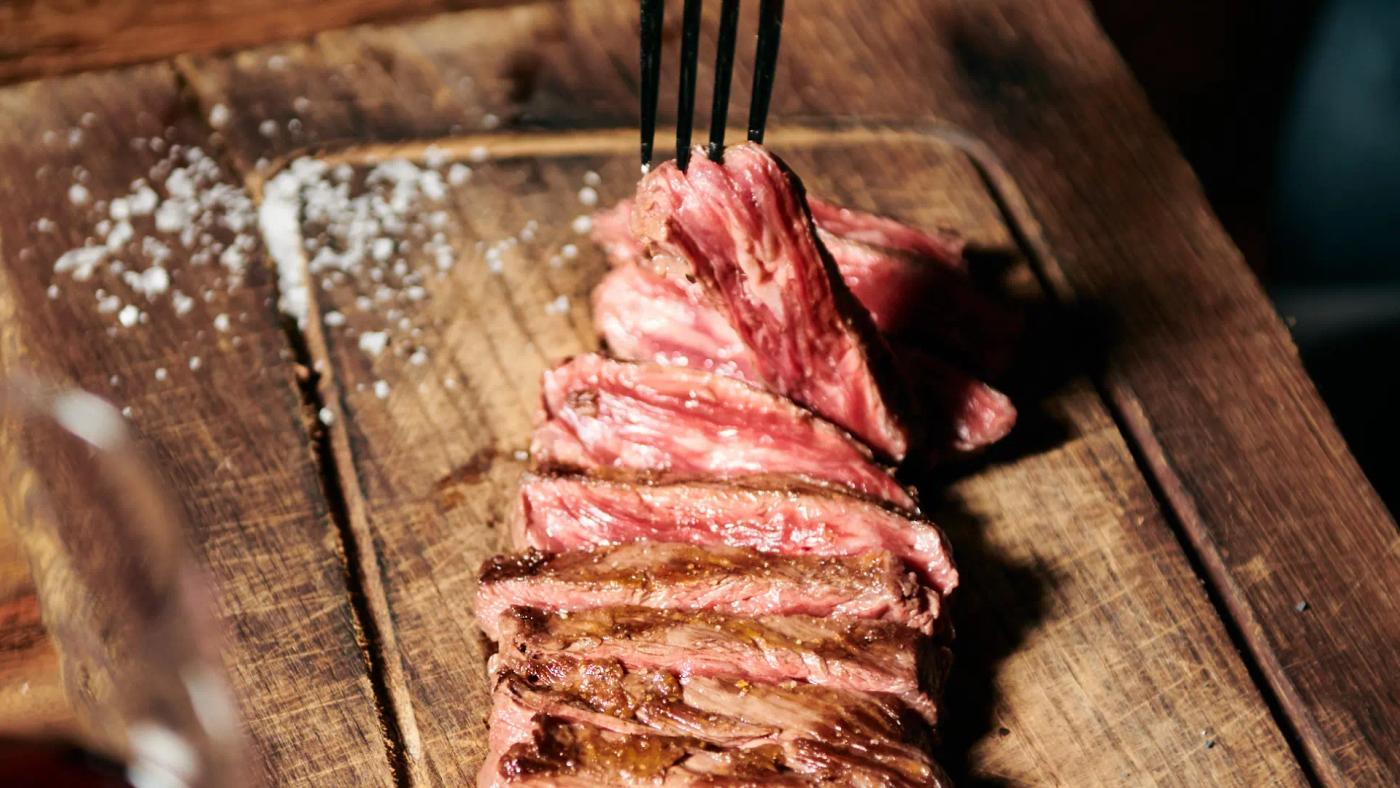
The better the meat, the less you should cook it: a piece with good marbling and long aging has all its grace in that fat infiltrated that melts with the heat. If you take it too far, that fat is lost, the fiber tightens, and you end up eating a worse version of what you ordered. A shame, after how hard it was to get there. No one will argue your point, far from it. But if you are in doubt, ask for one step less than you think: you can always give it another hit of the grill, and there is no going back in the opposite direction.
Why does the meat rest before reaching the table?
If you have ever noticed that your meat takes a little longer than you expected, it is most likely because it was resting. During cooking on the grill, the heat pushes the juices towards the center of the piece: if you cut it right out of the fire, all that liquid escapes to the plate and the meat remains dry; a few minutes of rest are enough for the juices to redistribute and stay where they have to be: inside. It is a silent step that you don't see from the table, but it is the one that marks the real line between a correct meat and one that you will remember weeks later.
At Carnal we work with selected pieces from Spain, Europe, Uruguay, Argentina, Japan, and Australia, each aged to its point and passed through wood fire. Doubts with the menu? Ask us and we will recommend according to what is in the fridge that week. We wait for you at Enric Granados 52, in the Eixample of Barcelona.